
If you live off base in Okinawa, you’ve probably noticed two things: the houses are big, and they get dirty in ways you’re not used to (salt, sand and mold — we cover that in a separate guide). So it’s no surprise that a lot of military families look for a housekeeper.
Here’s what weekly cleaning actually costs here, how pricing works, and what to check before you sign up.
The short answer
For a weekly visit to an off-base home in central Okinawa, expect to pay roughly $50–$150 per visit, depending mostly on the size of your home.
| Home size | What you’ll typically see per weekly visit |
|---|---|
| Studio – 1 bedroom | about $50–$105 |
| 1–2 bedrooms | about $90–$105 |
| 3 bedrooms | about $125–$135 |
| 4+ bedrooms | about $125–$150 |
These ranges come from published prices we could find in November 2026, including our own. One established English-speaking company lists about $105 a week for 1–2 bedrooms and $125 for 3–4 bedrooms. Prices change, so always ask for a current quote.
How pricing works here
Flat price by home size (most common for English-speaking services)
You pay the same price every visit, set by the number of bedrooms. This is the easiest to budget for, and it’s what most services aimed at the military community use.
Hourly rates (common with Japanese companies)
Japanese home-service companies and apps usually charge by the hour, per cleaner. Rates can look lower, but a large off-base house can take several cleaner-hours, and booking and communication are often in Japanese only.
Why bi-weekly costs more per visit
Almost every service charges more per visit for bi-weekly than weekly. That’s not a trick: when two weeks pass between visits, dust, soap scum and mold build up, and the clean takes longer. Over a month, bi-weekly is still cheaper overall.
Yen or dollars?
Local services usually bill in yen. That means your real cost in dollars moves with the exchange rate — when the yen is weak, yen-priced services get cheaper for you. Services that bill in dollars avoid that swing but may have set their prices with a cushion built in.
What’s usually included
A standard recurring clean covers the rooms you live in every day:
- Kitchen: counters, sink, stovetop, outside of appliances, microwave, floor
- Bathrooms and toilets: tub, shower, sink, mirror, toilet, floor
- Bedrooms and living areas: dusting, surfaces, making beds, vacuuming
- Genkan (entryway): sweeping and wiping down
- Floors throughout: vacuumed and mopped, trash taken out
Usually extra: inside the fridge or oven, interior windows, laundry, balcony, and yard work.
Usually not offered at all: exterior windows on upper floors, pressure washing, pet waste, and decluttering. Most cleaners will clean around things left out rather than put them away for you.
What makes one service better than another
Price is only part of it. These are the things that decide whether you’re still happy six months in:
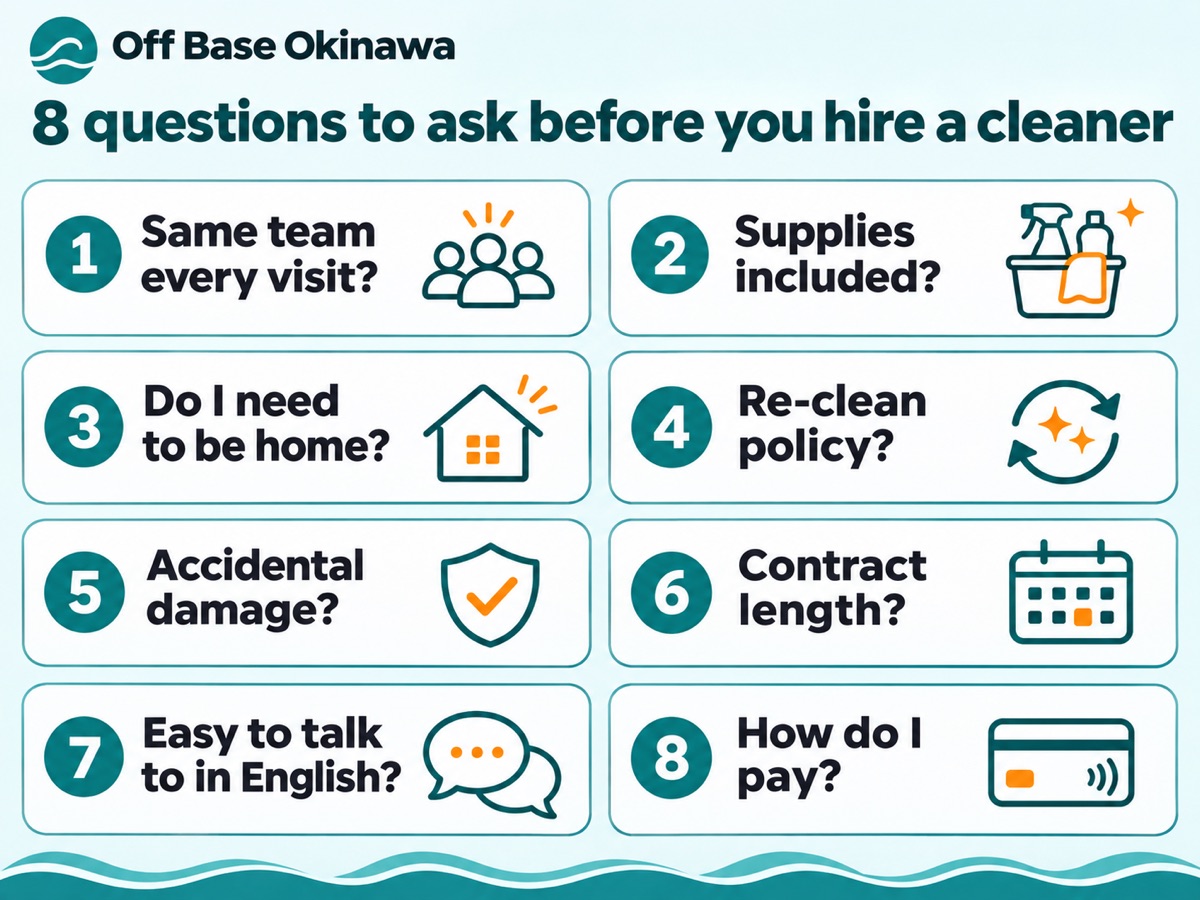
- Is it the same team every visit? A rotating crew means re-explaining your home every week. The same people learn where things go and what bothers you.
- Do they bring supplies? Most do. If they don’t, you’ll be buying Japanese cleaning products and figuring out which is which.
- Do you need to be home? Many families give a key or use a lockbox. Ask how the key is stored and who can access it, and whether they send photos when they finish.
- What if something isn’t right? Look for a re-clean policy — for example, tell them within 24 hours and they come back free.
- What if something gets broken? Ask directly how they handle accidental damage.
- How long is the commitment? Avoid long contracts. A 30-day notice to stop is fair; you never know when orders change.
- Can you talk to them easily in English? Quotes, rescheduling and small requests all go smoother when nothing is lost in translation.
- How do you pay? Card, bank transfer, PayPay or cash are all common. Paying monthly in advance is normal for recurring service.
A note on tipping
Tipping isn’t part of Japanese culture, and local cleaners won’t expect it. If you want to say thanks, a small gift or a kind review goes a long way.
Weekly or bi-weekly?
- Weekly suits families with kids or pets, larger homes, and anyone whose spouse is deployed and who simply needs one less thing on their plate.
- Bi-weekly works for couples and smaller homes where things don’t build up as fast.
If you’re not sure, start weekly for the first month while your home gets to a good baseline, then decide.
Our own prices
We run Tida Home Cleaning, so here’s exactly what we charge — no “contact us for pricing.”
| Home size | Weekly | Bi-weekly |
|---|---|---|
| Solo (studio – 1 BR) | ¥8,000 (≈ $52) | ¥10,000 |
| Couple (1–2 BR) | ¥14,000 (≈ $92) | ¥16,000 |
| Family (3 BR) | ¥20,000 (≈ $131) | ¥24,000 |
| Large (4+ BR) | ¥22,000 (≈ $144) | ¥26,000 |
Per visit, supplies and transport included, billed in yen (dollar figures at ¥153/$). Same team every visit, photos when we’re done, free re-clean if you tell us within 24 hours, and you can stop with 30 days’ notice. We cover Kadena, Chatan, Sunabe, Okinawa City, Yomitan, Ginowan and Uruma.
Whoever you choose, ask the questions above. A good service will be happy to answer all of them.