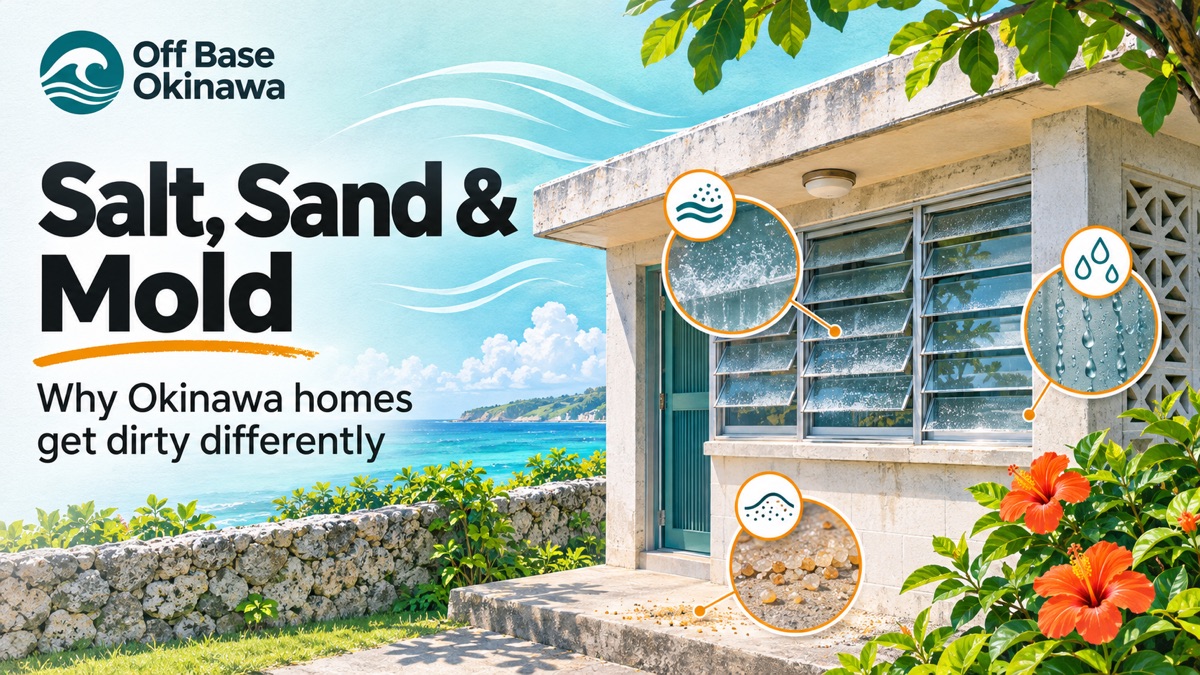
Most families who move off base in Okinawa notice it within a few months: the house gets dirty differently than it did back home. Windows turn hazy, metal rusts, closets smell musty, and there’s sand everywhere.
None of this means you’re doing anything wrong. It’s the island. Here’s what’s going on and what actually helps.
1. Humidity and mold: the big one
Okinawa is hot and humid for most of the year. The base itself warns newcomers about it, and recommends bringing dehumidifiers and fans (Kadena housing guide).
Off-base houses make it harder. Most are concrete, which holds moisture and stays cool, so damp air condenses on walls and inside closets. Mold loves:
- Closets and wardrobes, especially along outside walls
- Behind furniture pushed flat against a wall
- Bathroom ceilings, grout and silicone around the tub
- Air conditioner filters and vents
- Shoes, leather bags and belts stored in a closed genkan cabinet
- Under mattresses and futons
When it’s worst
The rainy season (tsuyu) in Okinawa normally runs from around May 10 to around June 21 — earlier than mainland Japan (Weathernews). The weeks just before it, when the air turns warm and heavy, are when many families first see mold appear.
What helps
- Run a dehumidifier or your AC’s dry mode (the setting marked 除湿 or “Dry”) during the humid months, especially in bedrooms and closets.
- Leave a gap of a few centimeters between furniture and outside walls so air can move.
- Open closet doors for an hour or two on dry days.
- Use moisture absorbers in closets and the genkan cabinet. Drugstores and supermarkets sell disposable ones; look for 除湿剤.
- Clean AC filters every two weeks in summer. A moldy filter blows spores around the whole room.
- Squeegee or wipe the shower after the last use of the day, and run the bathroom fan.
- Wipe early mold spots right away. Small spots come off easily; spots left for weeks stain grout and silicone.
Safety: Japanese mold removers (like Kabi Killer) are chlorine-based. Never use them together with acidic cleaners such as citric acid or vinegar-based products — the label warning 混ぜるな危険 means “dangerous if mixed.” Ventilate the room while you use them.
2. Salt: the one nobody warns you about
If you live anywhere near the coast — Chatan, Sunabe, Kadena, Yomitan — sea spray carries salt onto your house every windy day. After a typhoon, it can coat everything.
Salt shows up as:
- Hazy windows and sliding doors that look dirty again a day after cleaning
- Sticky, gritty window tracks and screen doors
- Rust on door handles, window cranks, railings, outdoor faucets, bikes and grills
- Crusty buildup on your air conditioner’s outdoor unit
What helps
- Rinse, don’t just wipe. Salt dissolves in water. Wiping dry glass just smears it. Rinse windows and screens with plain water, then wipe or squeegee.
- After every typhoon, hose down windows, screens, the AC outdoor unit (gently — no pressure washer on the fins), railings, and your car.
- Clean window tracks with a damp cloth or old toothbrush every few weeks so salt and sand don’t grind the rollers.
- Wipe metal fixtures with a damp cloth and dry them. A thin coat of protective spray on outdoor metal slows rust.
Typhoon season runs through summer and fall, so it’s worth building the “post-typhoon rinse” into your routine.
3. Sand and dust: beach sand, plus spring “yellow dust”
Beach sand comes home on feet, towels, toys and in the car. It scratches floors and gets into window tracks.
In spring, Okinawa also gets kosa — fine dust blown from the Asian mainland. It leaves a yellowish film on cars, balconies and window sills. The Japan Meteorological Agency publishes forecasts for it (JMA kosa information, in Japanese).
What helps
- Use the genkan the Japanese way: shoes off at the door, and a rough mat outside plus a soft mat inside.
- Keep a beach bucket by the door for rinsing feet and toys before they come in.
- Vacuum before you mop. Mopping sandy tile just moves grit around and scratches the floor.
- On high-dust days, keep windows shut and skip hanging laundry outside.
A simple year in an Okinawa home
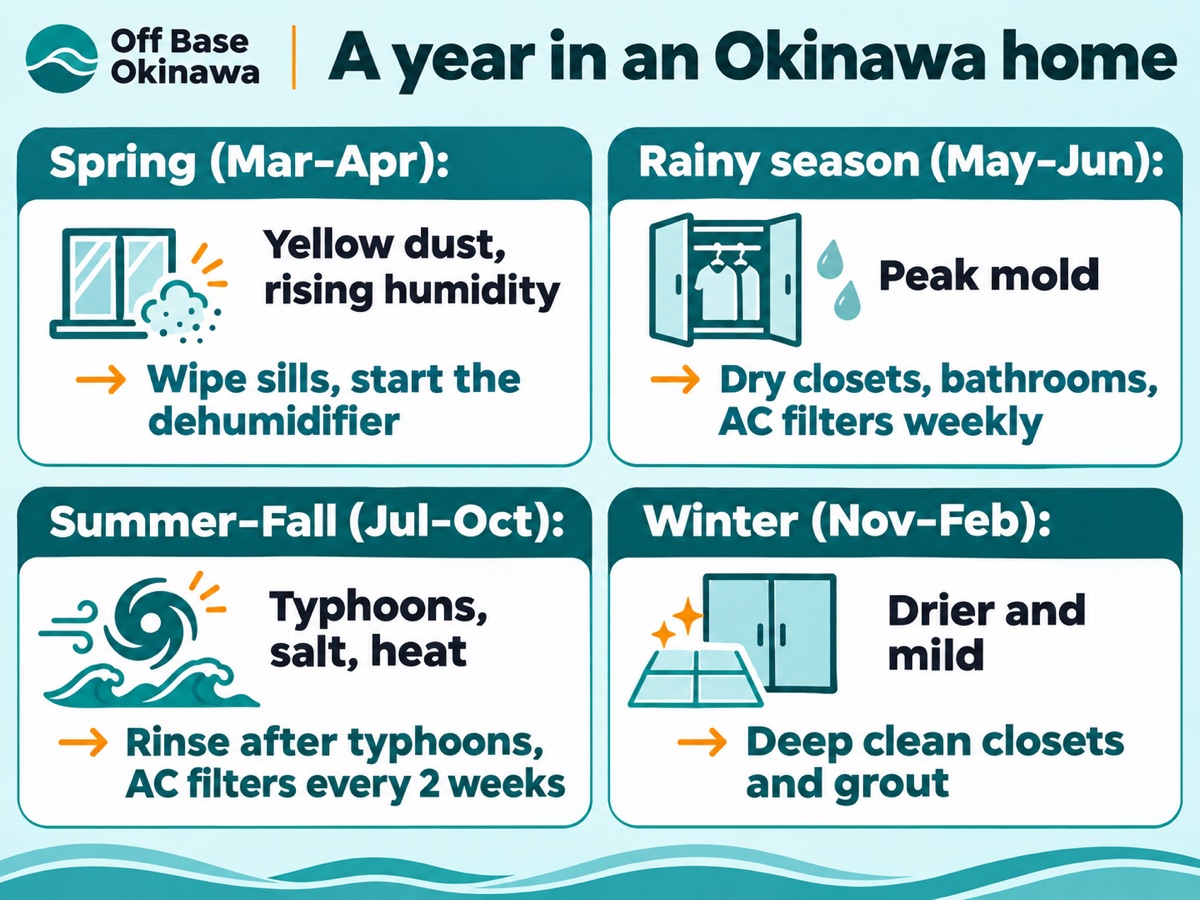
| Season | What to watch | Focus |
|---|---|---|
| Spring (Mar–Apr) | Yellow dust, rising humidity | Wipe sills and balconies, start the dehumidifier |
| Rainy season (May–Jun) | Peak mold | Dry closets, bathrooms and AC filters every week |
| Summer–fall (Jul–Oct) | Typhoons, salt, heat | Post-typhoon rinse, AC filters every two weeks |
| Winter (Nov–Feb) | Drier and mild | Deep clean closets and grout before next spring |
Why weekly cleaning helps more here than back home
In a dry climate, skipping a week of cleaning just means a bit more dust. In Okinawa, a skipped week gives mold time to take hold in the bathroom and lets salt and sand build up in tracks and on glass. Small, regular cleaning is what keeps an Okinawa house from needing a big, expensive rescue.
That’s why we recommend weekly cleaning for most off-base homes here, especially family-size houses near the coast. If you’d like a hand with it, our own service, Tida Home Cleaning, cleans off-base homes in central Okinawa every week. And if you’d rather do it yourself, the routine above will keep you ahead of the island.